
Aldridge Protest Highlights Conservative Hypocrisy
While Wendy Morton MP and council deputy Adrian Andrews back anti-development protests in one field, land tied to their party colleagues is being put forward just yards away.

As protesters gather today in Aldridge to defend the green belt, flanked and encouraged by senior Conservative figures, a rather different story is unfolding just a stone’s throw away
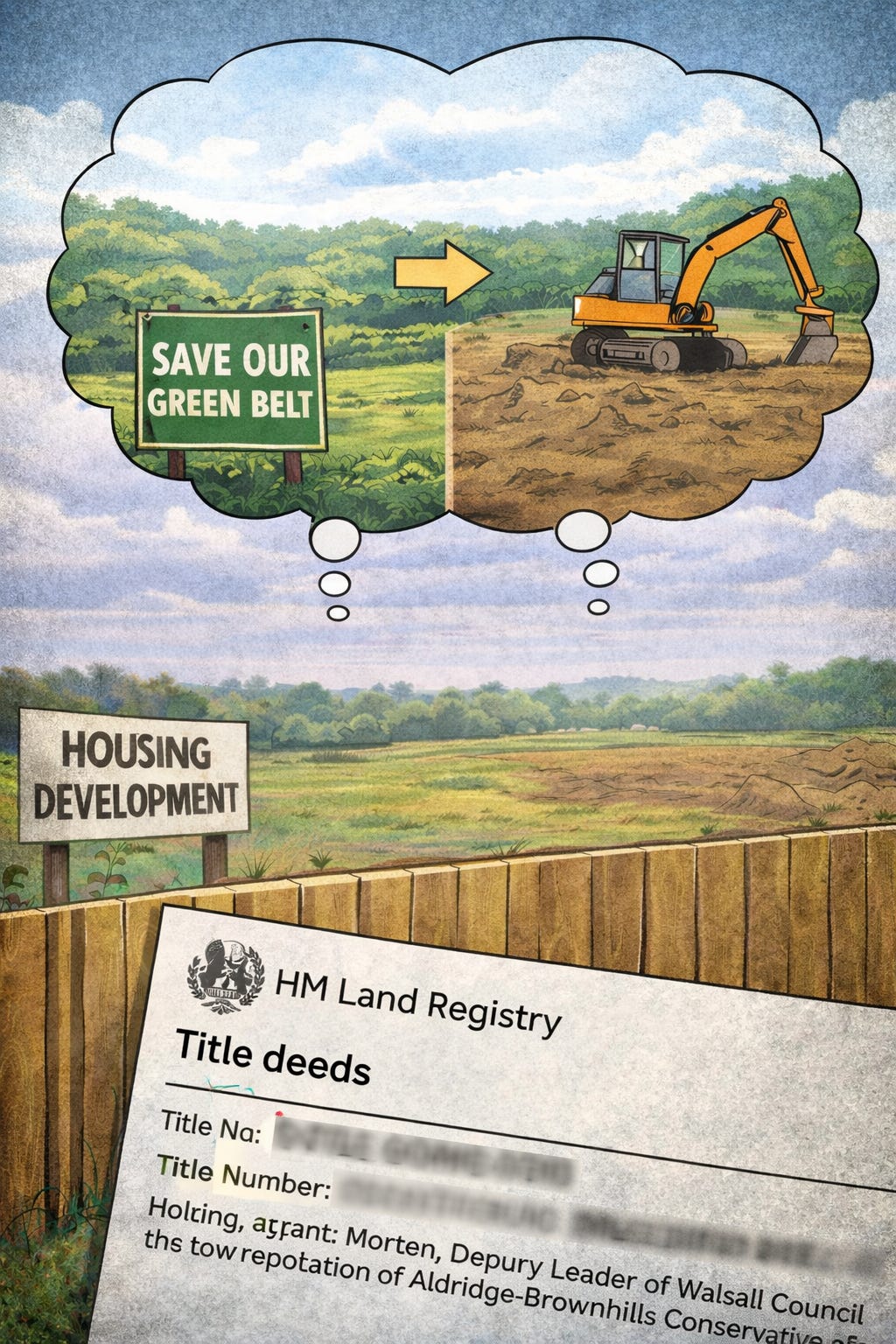
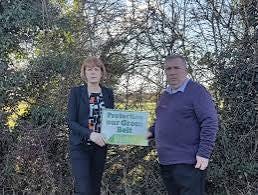
The campaign - openly supported by MP Wendy Morton and deputy leader of the council Adrian Andrews - has been framed in simple, compelling terms: this land matters, and it must be protected. Placards are raised, photographs taken, and the message projected clearly to residents and beyond.
And yet, just along that same stretch, sits Potters Wood. Green belt. A Site of Local Importance for Nature Conservation. And, crucially, ancient woodland - land continuously wooded since at least 1600, among the most protected categories in planning. In theory, the sort of place that should be beyond the reach of development. So why is it now in play?
Because this is not just any site. This author has seen the title deeds, and ownership links directly to the chair of the Aldridge-Brownhills Conservative Association. No rule forbids that. But it changes the question.
This is no longer simply about planning policy; it becomes about political consistency. Can the same political machine campaign to stop green belt development while being tied - however indirectly - to advancing it? And are we really going to believe that Moreton, Andrews & Bird were unaware of their friend and colleague's proposals?
The more cynical amongst you might point to a different pattern emerging… one where senior leaders squeeze the housing need in Walsall to increase demand, whilst simultaneously carving empty or derelict land up between friends to sell at peak value. One might point to a pattern of distraction, for the Aldridge protest see Potters Wood. For the Leather Museum see Hawbush Road. There are many more which are also coming to light.
Then there are the open rumours online that certain owners of large derelict sites in the town brag publicly about having council leaders ‘on a retainer’ and that they can ‘get anything done’. For the right price of course.
Potters Wood surfaced through the Council’s Regulation 18 stage - the early “call for sites” inviting landowners and agents to suggest land for future development. A parcel linked to Oakwood House was submitted by an agent on behalf of “their client.” The submission itself is blunt; others responding to it expand the case, pointing to shifting housing pressures since elements of the Black Country Plan fell away. Opponents point, just as firmly, to green belt protection, ecological value, and cumulative loss.
Interestingly on many of these online consultations, it seems that whenever an objection is submitted immediately one more comment in favour of the proposal arrives soon after, and even heavily critical comments are rated ‘positive’. If that is the data used to inform decision making then the process is certainly worthy of closer examination.
Across Walsall, green belt development is increasingly justified as necessity - housing targets, changing policy, the steady softening of lines once described as firm. Barr Lakes offers one clear example. But in Aldridge, something more politically awkward is happening.
The same party - from MP to Deputy Leader - campaigning against development in one field while being tied to it in another. Political NIMBYism (not in my back yard), plain and simple: unacceptable here, arguable there.
No illegality is required. The issue is whether the public is expected to accept it. If green belt protections mean anything, they must apply consistently. If they are flexible, that should be said openly. What cannot stand is protest on one site and promotion on the next.
Would Potters Wood be in play without shifting housing policy? Perhaps. Would it feel as contentious without political connection? Almost certainly not, and that is the point.

Because as residents gather today to defend the green belt, the question is no longer just about what is being built—but whether those leading the resistance believe the rules they invoke apply equally to themselves.
I take your comment, but the article also makes it sound as though Conservative Councillors have led the campaign. They haven't. They have been very supportive of the campaign led by an action group of local residents and that has also been the case with people from other political parties.
The point with any piece of land is whether it is appropriate for building on, not who owns it.