
Walsall Conservatives: When a Party Selects Itself
Deselections, returns, family optics, recycled candidates and a retreat to safer wards leave Walsall Conservatives facing serious questions before polling day.

The public is often told that local politics concerns bins, potholes and bus shelters. In Walsall, it increasingly resembles the court politics of a regime ancien: whispers in corridors, rivals removed, favourites restored, wards treated as chessboard squares, and decisions made somewhere between the committee room and the curtain rail.
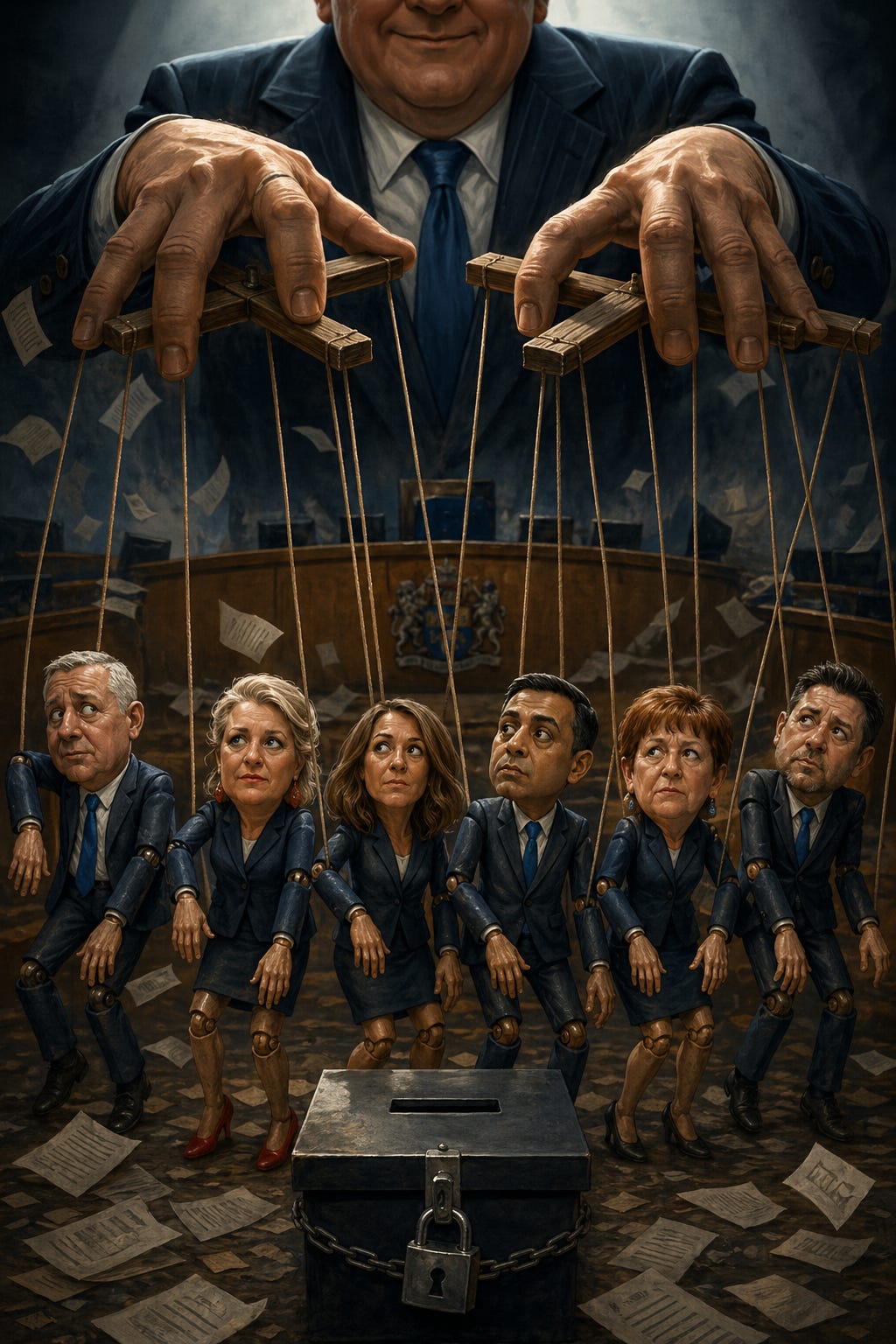
With the May 7 local elections approaching, the internal manoeuvres surrounding Conservative selections have become a story in their own right. What ought to have been a routine process of choosing the strongest candidates to represent residents has instead generated confusion, resentment and a series of questions the party appears curiously reluctant to answer plainly.
Streetly has become the emblem of the disorder. Two sitting councillors, Suki Samra and Sarah Jane Cooper, publicly announced they would not stand, issuing a striking statement lamenting the treatment of “dedicated and hardworking councillors” during the reselection process. They referred to victimisation, inconsistent decisions, bullying, unfair treatment and a process lacking transparency. Those were not opposition activists complaining from afar. They were Conservatives describing their own side.
That alone should have rung alarm bells. Yet matters only grew stranger. Public campaign material and circulated screenshots then suggested that candidates who had previously failed to secure selection elsewhere were later placed into Streetly instead. Amanda Parkes was among the names discussed in that context, with posts alleging she had previously been turned down before subsequently reappearing in the selection picture. If accurate, voters are entitled to ask whether candidate assessment is based on principle or convenience, especially when the candidate has close ties to other controversial individuals.
Alongside that came the candidacy of Cara Babb, drawing inevitable scrutiny because of her family connection to council leader Mike Bird. No sensible person claims relatives must be barred from politics. Merit exists in families as it does elsewhere. But when a party is already accused of opaque selections and internal favouritism, placing close relations of senior figures into the frame invites exactly the sort of suspicion competent operators usually avoid.
Elsewhere, Keith Sears has become a symbol of another grievance. Having reportedly been deselected before later returning to the fold, his case has been cited by critics as evidence of a process that appears less governed by clear principle than by shifting internal necessity. If a candidate is unsuitable on Monday but suitable by Friday, voters are entitled to ask what changed: the facts, or the factional arithmetic.
Then there are the names around the wider machine. Barbara Haig, publicly identified as chair of the Aldridge-Brownhills Conservative Association, has recently been the subject of controversy after comments reported in connection with a local protest over housing proposals generated criticism and sharpened tensions around accountability. Whatever view one takes of that episode, it added to an atmosphere of growing distrust rather than calming it.
JonJo MacNamara has also entered public discussion for less flattering reasons. Publicly available reports identify him as having previously admitted theft from an employer in an earlier criminal case. People can, of course, rebuild their lives after wrongdoing and many do. The point here is not eternal punishment. It is judgement. When a party already facing accusations of poor standards and opaque internal culture surrounds itself with controversial baggage, voters are entitled to ask whether lessons are ever learned.
Then there is the geography of power. Streetly and Pheasey Park Farm have long been regarded as comparatively safer Conservative territory. It has therefore not gone unnoticed that senior figures appear to be consolidating precisely there. In Pheasey, Mike Bird and deputy leader Adrian Andrew are both standing, alongside an endorsed ally, creating the unmistakable impression of a leadership retreating to defensible ground in uncertain times. When generals abandon the frontier and crowd into the citadel, observers usually infer that they have seen a foreboding future. Rather than projecting confidence across the borough, the party’s leading names appear concentrated where the electoral terrain is friendliest.
Then there is the matter of performance. Critics have circulated previous Freedom of Information responses concerning councillor casework levels, arguing that some figures raise awkward questions about how candidates are chosen and retained. Such figures should always be treated carefully and with context; raw data can mislead. Yet the political point remains unavoidable. If councillors with apparently modest public-facing records are restored, moved or protected while others complain of being sidelined, residents are entitled to ask what criteria are actually being applied.
Is it electoral strength? Administrative competence? Community roots? Independence of mind? Loyalty to the leadership? Silence at the right moments? The party has not said, and in politics silence often speaks with uncommon eloquence.
The wider irony is that Walsall Conservatives have already had an opportunity to reform themselves and appear to have let it pass. When Mike Bird was suspended in 2024, Gary Perry stepped into the leadership role and commissioned a review into council procedures, including governance and planning processes. Many hoped the interruption in the old order might produce overdue introspection and modernisation.
Instead, Bird returned, Perry departed, and the recommendations from that interlude appear to have vanished into the municipal mist. If there was to be a reset, residents could be forgiven for missing it.
That matters because the current selections controversy does not arise in isolation. It sits within a broader pattern: rows over transparency, public frustration over major decisions, controversies around planning, criticism from councillors themselves, defections and returns, and increasingly brittle responses to scrutiny. Selection chaos merely confirms what many had already suspected: that internal management has become an end in itself.
Taken separately, each episode may be explained away. Together, they form a picture.
And it is one voters would be wise to question before they are asked to trust it.
Put Walsall First.
#walsall #walsallcouncil #election #mayeelection #localelection #conservativeparty #mikebird #adrianamdrew #carababb #amandaparkes #keithsears #pheasey #Streetly #Aldridge #pheaseyparkfarm #localgovernment #community #change #vote